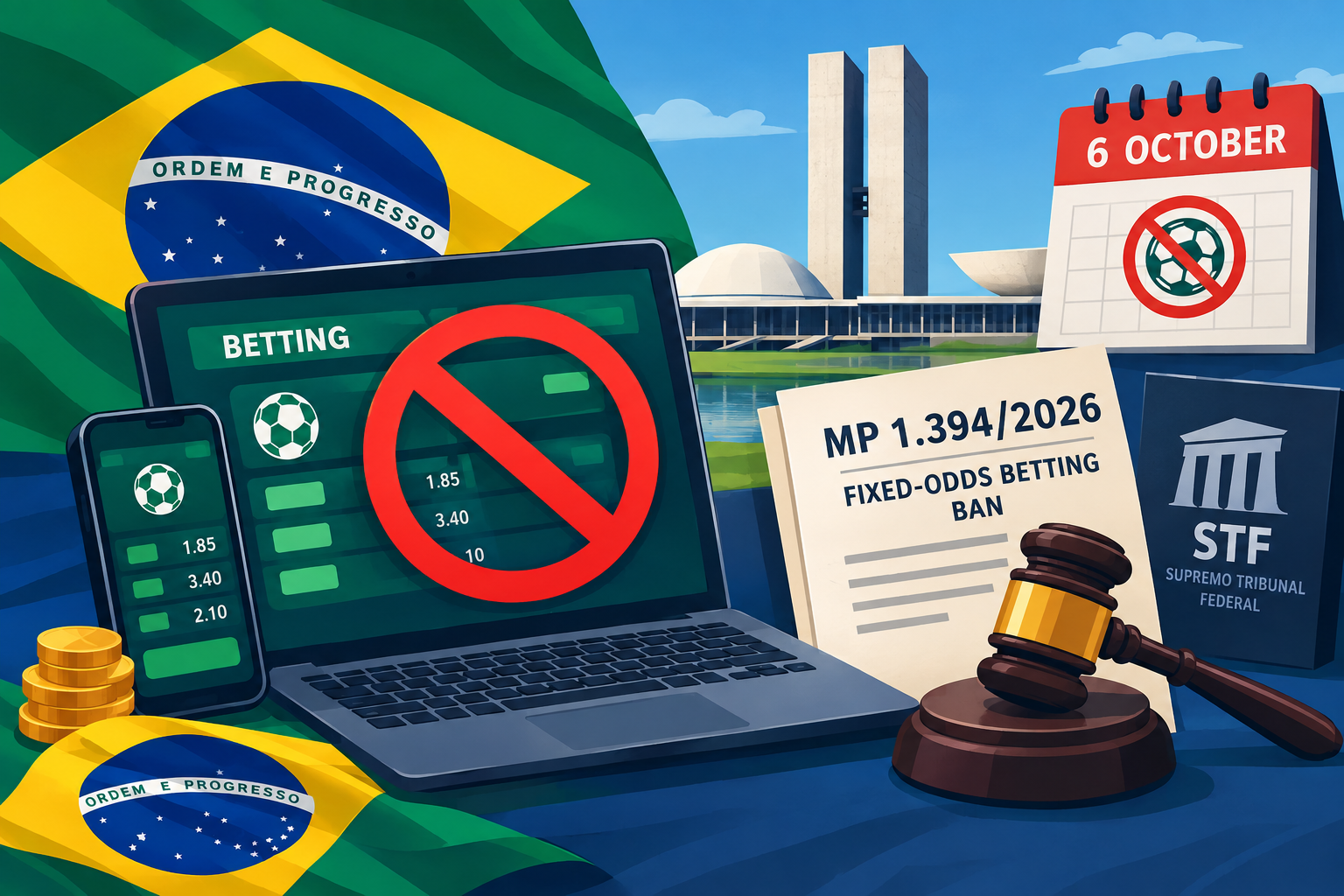
Brazil Weighs Online Casino Ban as Regulated Market Expands
Brazil is reportedly weighing a proposal to restrict online casino games, but no measure has been issued and the scope of any potential ban remains unresolved.

No decision has been made, but Brazil's federal government is reportedly preparing a proposal that could prohibit online casino games, according to Reuters and other Brazilian reporting on 17 September 2026. The mechanism under discussion is a medida provisória (MP) — a measure that takes effect immediately upon publication but must be ratified by Congress to remain in force. The measure has not been issued, its final text is not public, and no MP number or official government confirmation has been identified.
Reuters, citing four sources familiar with discussions inside the presidential office, reported that the government is preparing to ban online casino operations, with the text possibly ready "in the coming days." Two of those sources said the measure would not cover sports betting or sports sponsorships directly, though other Brazilian reporting has described a potentially broader scope, leaving the final shape of the proposal unresolved.
The development comes less than two years after Brazil launched its current regulated betting and gaming framework, and it has already drawn reaction from licensed operators, football clubs and industry associations who argue the state cannot ignore the financial consequences of restricting an activity it recently authorized.
Brazil's Proposed Measure Has Not Yet Been Issued

No draft MP text, decree number or official government statement confirming a casino ban has been published as of 17 September. Reuters' report, bylined from Brasília, is based on anonymous sources described as familiar with discussions within the Palácio do Planalto, and one source described Lula as intending to act on the issue, while stressing the matter remains under discussion between the president and his ministers.
Under Brazil's constitutional framework governing provisional measures, an MP takes effect upon publication and remains in force for up to 60 days, with its validity extendable once for an additional 60 days, unless converted into law by Congress, a structural feature relevant to any claim that the measure would permanently ban online casino products. Sources cited by Reuters said Lula could sign off on the measure before the 4 October first round of Brazil's general election, though no official government timetable has been published, and this detail remains attributed to anonymous officials rather than a confirmed calendar.
Online Casinos Are at the Center of the Proposal
According to Reuters, the government's focus is on online casino operations specifically, rather than the betting sector as a whole. The reporting does not specify which individual product categories — such as slots, live-dealer games, crash-style titles or online poker — would fall under the prohibition, and no authoritative source has confirmed the measure's exact product scope. Brazilian media, including CNN Brasil, have separately floated the possibility that popular slot-style "tigrinho" games could be a specific target of concern, though this has not been confirmed as part of any finalized text.
Sports Betting Could Remain Outside the Direct Ban
Reuters reported, citing two sources familiar with the discussions, that sports betting and sports-club sponsorships would not be covered directly by the proposed measure. Other Brazilian reporting, including from UOL on 16 September, has described a potentially broader measure encompassing both online betting and games — a characterization Reuters has not corroborated — leaving the final scope of the proposal unresolved.
Even under the narrower Reuters framing, officials acknowledge indirect effects on sports betting are likely, because most of Brazil's licensed operators run both casino and sports-betting products under the same brand, and casino games account for a large share of operator revenue, according to Reuters' reporting. Football clubs including Flamengo, Corinthians, Palmeiras and São Paulo hold sponsorship contracts with betting operators — Flamengo's deal with Betano is widely reported at up to R$268.5 million per season — and Brazilian outlets have estimated aggregate Série A sponsorship exposure at roughly R$1 billion, a figure industry participants have cited as at risk if operator revenue from casino products is curtailed.
Brazil's Regulated Market Has Grown Rapidly
Brazil's regulated fixed-odds betting and online gaming market, established under Law 14.790/2023 and operating since 1 January 2025, began with 71 initial federal licenses. Reuters reported that Brazil currently has 188 authorized betting operators, a figure also reflected in several September industry and Brazilian media reports, though the count should be understood as operator-level authorizations rather than brands or domains, and should be verified against the live SPA/MF registry before publication.
Casino Revenue Is a Major Part of the Business for Some Operators
A source involved in the discussions told Reuters that online casino games account for between 50% and 70% of revenue at some operators — an industry estimate that applies to specific operators rather than the market as a whole. The Ministério da Fazenda separately estimates Brazilian households spend roughly R$60 billion a year on betting, according to Reuters' reporting, a figure the ministry attributes to its own analysis rather than an independent audit.
Billions in Government Revenue Are at Stake
Treasury data cited by Reuters show the government collected nearly R$10 billion in 2025 from license fees and taxes on the sector. Separately, some Brazilian outlets have reported approximately R$10 billion in sector-related revenue collected between January and July 2026 — a different figure covering a different period, and one that should not be conflated with the 2025 Treasury total. One source indicated the Ministério da Fazenda anticipates revenue losses if the measure proceeds, while flagging an unresolved question over whether operators could be owed partial refunds of the license fees they paid to operate casino games.
Operators Could Face Legal Questions Over Licensing Fees
Industry representatives have raised the prospect of compensation claims tied to the outorga fees operators paid for authorization. The Associação Nacional de Jogos e Loterias (ANJL) has argued that any restriction on the regulated market should be preceded by economic and legal impact studies. Its legal counsel, Bernardo Cavalcanti Freire, told Reuters: "If the State restricts an activity for which it granted authorization through payment of a license fee, it cannot ignore the financial consequences of that decision." In a preliminary estimate, Freire said, compensation-related exposure could reach R$120 billion — a figure that originates from ANJL's own legal analysis, not from a government agency or court ruling.
Illegal-Market Concerns Add Another Layer
The proposed casino restrictions arrive alongside an existing government push against unauthorized operators. The SPA/MF published Portaria SPA/MF nº 2.750/2026 on 14 September, strengthening measures against illegal platforms by requiring financial institutions to act on payment-blocking within 24 hours of regulator notification. Industry participants have warned that removing regulated casino products from the legal market could push activity toward unauthorized operators. Consultancy LCA Consultores, working with Instituto Locomotiva, has estimated that in a scenario involving a casino ban, between R$82 billion and R$100 billion in activity could migrate to the illegal market over four years — a projected scenario from a private consultancy, not a government forecast or an observed outcome, since no ban has yet taken effect.
Responsible Gambling Is Part of the Broader Debate
Lula has repeatedly voiced concern about gambling's effect on household finances. In a podcast interview reported this week, he said: "We are discussing it. I've already held three meetings within the government and met with civil society, and my personal position is to end betting," while adding that the government must act "with much responsibility." No officially published justification or policy document accompanies these remarks, and no finalized government position has been confirmed.
What Happens Next?
Several questions remain open: whether the government issues an MP at all, whether its text becomes public, whether sports betting and advertising are ultimately included or excluded, how Congress responds within the 120-day conversion window, and whether operators pursue legal challenges over licensing-fee compensation. None of these outcomes has been determined as of 17 September 2026.
Sources
Reuters, "Brazil plans executive order to ban online casinos, sources say" (17 September 2026); Ministério da Fazenda/Secretaria de Prêmios e Apostas (SPA/MF), Portaria SPA/MF nº 2.750/2026 (14 September 2026); UOL (16 September 2026); Associação Nacional de Jogos e Loterias (ANJL) statements as reported by Reuters.