
UAE Strengthens Gaming Oversight as GCGRA and Abu Dhabi's Financial Regulator Formalize Cooperation
GCGRA and ADGM's FSRA have signed an MoU formalizing regulatory cooperation on UAE commercial gaming. Here's exactly what it covers — and what it doesn't.

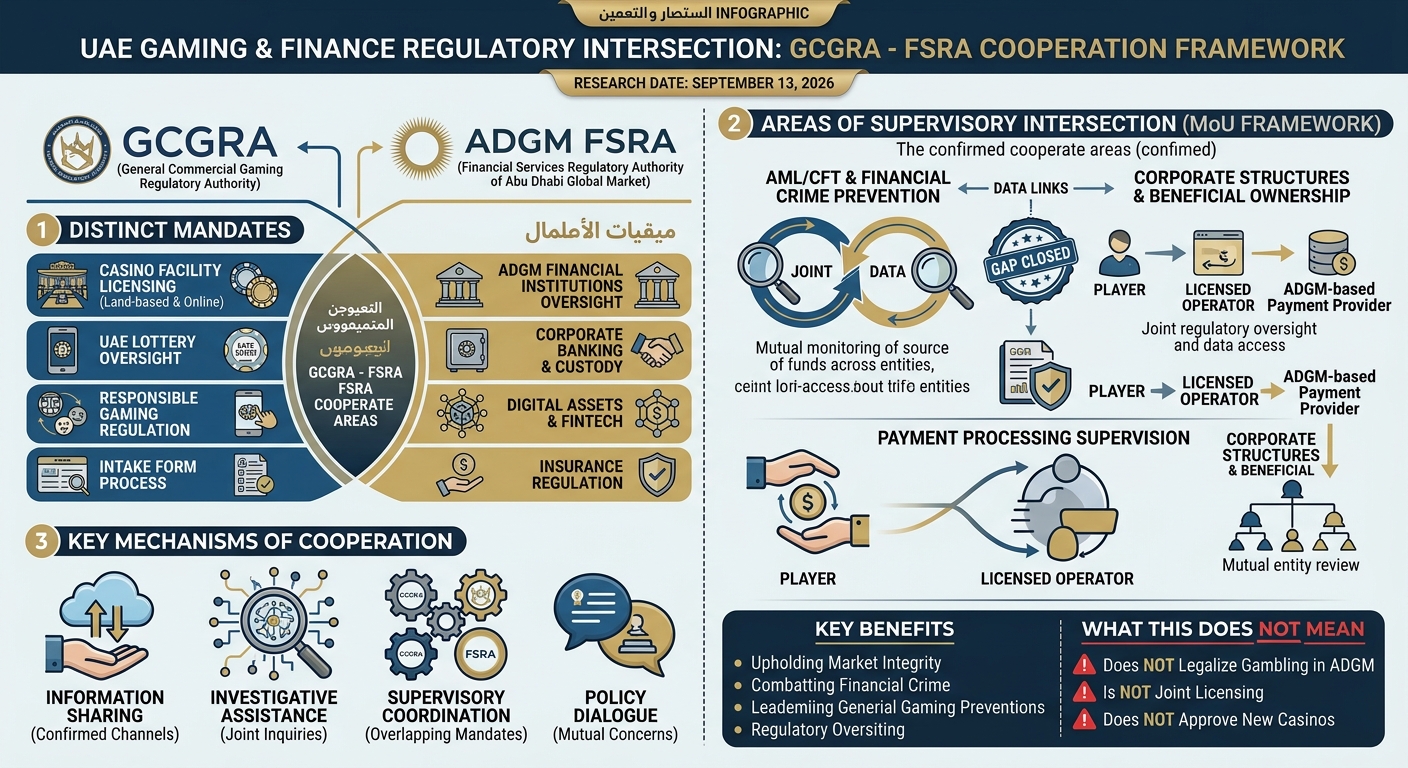
A new memorandum of understanding links the UAE's federal commercial-gaming regulator with Abu Dhabi Global Market's financial watchdog, creating a formal channel for information sharing and supervisory coordination as the country's regulated gaming sector develops.
The General Commercial Gaming Regulatory Authority (GCGRA) and the Financial Services Regulatory Authority (FSRA) of Abu Dhabi Global Market (ADGM) have signed a Memorandum of Understanding establishing a formal framework for regulatory cooperation, the two authorities announced on August 14, 2026.
The agreement was signed by GCGRA chief executive Ciarán Carruthers and FSRA chief executive Emmanuel Givanakis. According to the official announcements, the MoU creates channels for information exchange, supervisory coordination, policy dialogue and investigative assistance between the two regulators, with all cooperation subject to applicable laws and confidentiality requirements.
The significance is institutional rather than transactional. GCGRA is the UAE's federal regulator for commercial gaming, while FSRA regulates financial services within ADGM, an international financial free zone on Abu Dhabi's Al Maryah and Al Reem islands. As licensed gaming operators increasingly rely on banks, payment processors and other regulated financial entities, the two regulators are establishing a formal mechanism to close supervisory gaps where their respective mandates intersect. The agreement does not create new gaming licenses, authorize gambling within ADGM, or approve any specific operator or project.
What the Regulators Actually Agreed

Based on the official announcements from both authorities, the MoU's confirmed scope includes:
- Information sharing — a defined channel through which the two regulators can exchange regulatory information.
- Supervisory coordination — cooperation in areas where GCGRA's gaming mandate and FSRA's financial-services mandate overlap.
- Investigative assistance — support between the authorities on matters requiring cross-agency input.
- Policy dialogue — ongoing communication on issues of mutual regulatory concern.
Both authorities describe the arrangement as intended to support market integrity and consumer protection while each regulator continues to operate independently within its own statutory mandate. Neither announcement uses the term "AML" or "CFT" explicitly, though both regulators' broader remits already include financial-crime responsibilities in their respective sectors — GCGRA within commercial gaming, FSRA within ADGM-regulated financial services.
What the public announcements do not specify is equally important. There is no detail on the exact categories of information to be exchanged, the frequency of coordination, or whether the arrangement extends to joint investigations rather than one-way investigative assistance. The full text of the signed MoU has not been made public, so operational specifics should be treated as unconfirmed until the authorities disclose them.
Why the GCGRA–FSRA Relationship Matters
Commercial gaming generates substantial payment flows and holds significant customer funds, which inevitably brings licensed operators into contact with banks, payment processors and other financial institutions. GCGRA already supervises financial-crime prevention within the gaming sector, requiring licensees to maintain transaction monitoring, customer due diligence and suspicious-activity reporting. FSRA separately maintains its own anti-money-laundering and counter-terrorist-financing framework for financial-services entities operating within ADGM.
This could matter because, without coordination, a gap can exist between how a gaming regulator screens a licensed operator and how a financial regulator screens the bank or payment provider that operator relies on. Formalizing an information-sharing channel between the two authorities is a logical step as the UAE's commercial-gaming sector — still relatively new — becomes more deeply integrated with the country's wider financial infrastructure. This reading reflects the authorities' stated rationale and independent legal commentary rather than a specific provision spelled out in the public announcement.
GCGRA's Role in UAE Commercial Gaming
GCGRA was established as a federal authority in September 2023 to regulate commercial gaming nationwide, under legislation the regulator identifies as its founding framework for the sector. It holds exclusive jurisdiction over licensing and supervision of commercial gaming activities across the UAE, including land-based gaming facilities, lottery, sports wagering and internet gaming.
The regulator's public licensee register currently lists several categories of operators, including land-based gaming facilities and internet gaming and sports-wagering licensees. Operating commercial gaming in the UAE without a valid GCGRA license remains illegal, and the regulator has said unlicensed operators — and in some cases the consumers who use them — can face penalties.
Carruthers became GCGRA's chief executive in June 2026, succeeding inaugural CEO Kevin Mullally. He is the GCGRA signatory to the August MoU.
Where ADGM and FSRA Fit In
ADGM is an international financial center operating under English common law within Abu Dhabi. FSRA is its independent financial-services regulator, responsible for licensing and supervising banking, capital markets, asset management, insurance and digital-asset activities conducted within the zone. FSRA does not regulate gambling, and the MoU does not change that — its core mandate remains financial-services supervision.
The distinction matters for accurate reporting: this is not an agreement that brings gaming regulation under ADGM's jurisdiction, nor does it grant FSRA any gambling-oversight authority. It is a cooperation arrangement between two separate regulators with separate statutory remits, entered into because those remits can intersect in practice.
How This Fits Into the UAE's Emerging Gaming Market
The MoU arrives against the backdrop of a market that has moved from outright prohibition to a structured, licensing-based federal system within roughly three years. GCGRA awarded the UAE's first national lottery license to The Game LLC in mid-2024. Wynn Resorts' Ras Al Khaimah project — now operating through the licensed entity Island 3 AMI FZ-LLC, doing business as Wynn Al Marjan Island — received the UAE's first Commercial Gaming Facility Operator license in October 2024; Wynn Resorts' own investor disclosures indicate the property is currently expected to open in September 2027.
On the online side, an internet-gaming and sports-wagering license was issued to Coin Technology Projects LLC, which operates the Play971 platform — currently the country's publicly identified licensed online gaming and sports-betting operator.
Separately, a new UAE Civil Transactions Law took effect on June 1, 2026, removing gambling- and betting-related provisions that existed in the prior civil code. Some legal analysts have noted this change alongside the broader development of the GCGRA licensing regime, though it is a distinct piece of legislation and is not itself part of the GCGRA–FSRA MoU.
The GCGRA–FSRA MoU is best understood as the next step in that broader institutional build-out: having established licensing categories and a functioning market, the federal gaming regulator is now formalizing its links with adjacent parts of the UAE's regulatory ecosystem.
What the Agreement Does Not Mean
Given how easily regulatory cooperation stories can be overstated, several clarifications are warranted:
- This is not legalization of online gambling. Online gaming and sports wagering are already regulated activities under GCGRA licensing, established before this MoU. The agreement does not expand what is or isn't permitted.
- ADGM has not become a gambling jurisdiction. FSRA's mandate remains financial services; it has not been granted authority to license or approve gaming activity.
- No casino has been approved or launched through this agreement. Wynn Al Marjan Island's license predates the MoU by nearly two years and is unrelated to it.
- The MoU is not confirmed to be an AML-specific agreement. While financial-crime prevention is relevant context for both regulators, the public announcements describe general regulatory cooperation rather than a dedicated AML data-sharing protocol.
- There is no evidence of joint licensing or joint enforcement powers. "Investigative assistance" is confirmed; a formal joint-investigation mechanism is not.
What Comes Next for UAE Gaming Regulation
As of mid-September 2026, neither GCGRA nor ADGM had published further detail elaborating on the MoU's operational mechanics, and no specific licensing, enforcement or supervisory action has been publicly tied to the agreement. Independent legal commentary published in early September noted the arrangement's significance as a formal regulator-to-regulator link, while also flagging that the public announcement offers limited detail on how cooperation will work in practice.
For the iGaming industry, the relevant takeaway is structural rather than immediate: as the UAE's commercial-gaming framework develops, the regulatory infrastructure surrounding the sector is being built out in parallel. For operators, payment providers and financial institutions exposed to UAE-licensed gaming, the practical question now is how the two regulators translate the cooperation framework into day-to-day supervision. Any further guidance, enforcement action or disclosure of the MoU's operational mechanisms will provide a clearer indication of how closely gaming and financial-services oversight will become aligned.