Brazil's Betting Market Enters a New Enforcement Era: 14 Brands Suspended as Political Pressure Builds
Brazil's regulated betting market is facing a tougher test as 14 brands are suspended, consumer protections tighten, and political pressure against betting grows.

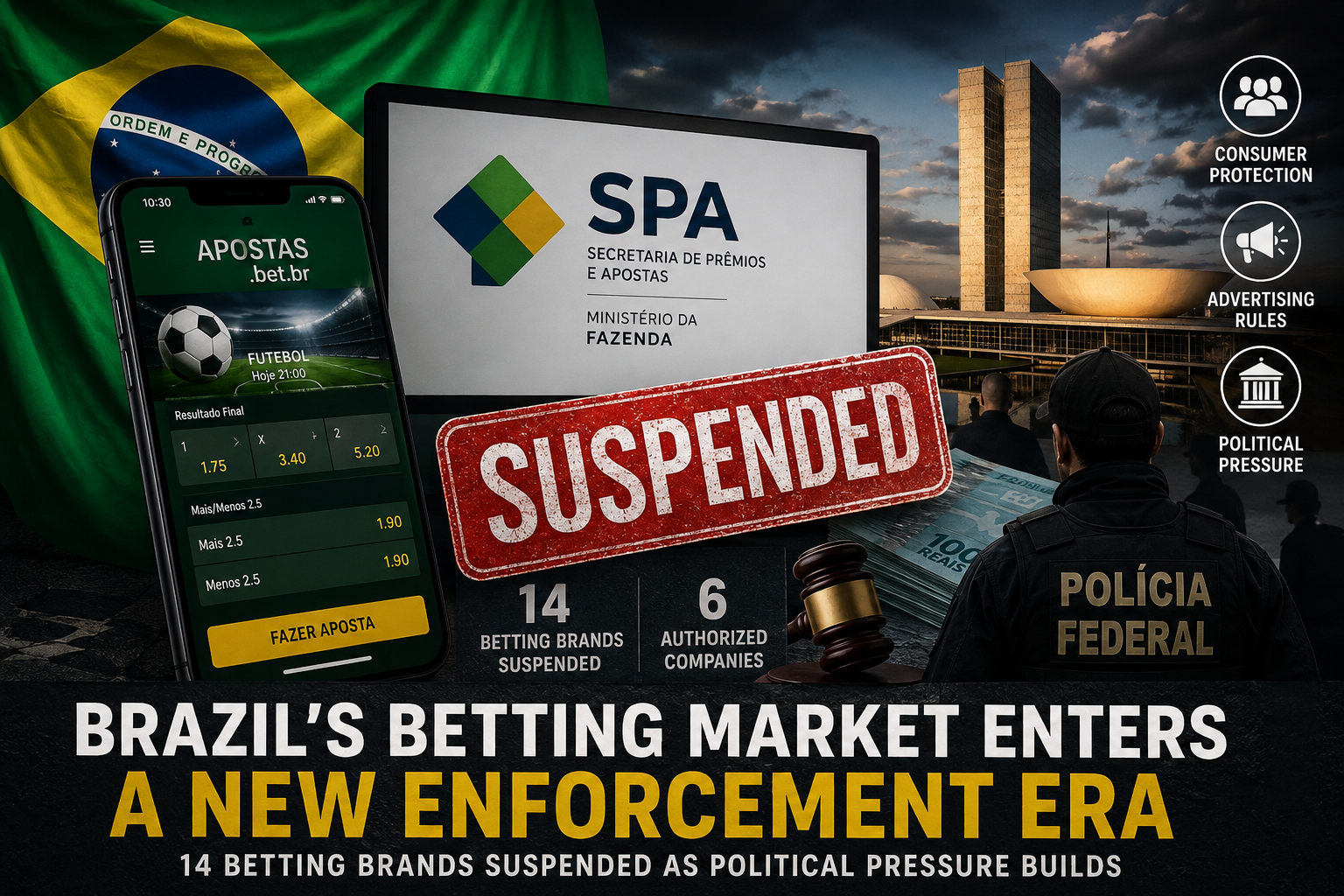
Brazil's betting market spent its first phase building a licensing system. In August 2026, Brazil's betting regulation entered a tougher, more consequential phase, as authorities began demonstrating what happens after the licenses are issued.
On August 13 and 14, Brazil's Secretariat of Prizes and Betting (SPA) imposed precautionary suspensions on 14 betting brands operated by six authorized companies, citing failures involving responsible-gambling controls and information required for regulatory oversight. The measures covered brands operated by Pixbet, Zeroumbet, Enseada, Select Operations, Nexus International and RR Participações.
At almost exactly the same time, a separate federal investigation known as Operation Arena targeted a business group suspected of tax evasion, foreign-exchange violations and money laundering. Federal Police and tax authorities executed 17 search-and-seizure warrants across five states, with court authorization to seize up to R$1.1 billion in assets and values.
Neither development means Brazil is abandoning regulated betting. There is no evidence of a current nationwide ban. Instead, August is showing something potentially more consequential for the industry: Brazil's regulator is moving from the administrative work of authorizing operators to the harder task of enforcing the rules, while consumer-protection measures and political opposition push betting higher up the national agenda.
Brazil's betting market: August 2026, by the numbers

- 85 — authorized operating companies
- 14 — betting brands suspended
- 6 — authorized companies affected
- 40 million — active SIGAP users cited by the Ministry of Finance
- ~800,000 — people currently blocked from betting following debt-renegotiation restrictions
- ~10% — share of active SIGAP users represented by people excluded through debt-renegotiation restrictions, social-program restrictions and self-exclusion, according to the Ministry of Finance
- R$1.1 billion — maximum value of assets subject to seizure in Operation Arena
- 17 — search-and-seizure warrants executed in Operation Arena
- 5 — Brazilian states involved in Operation Arena
The suspension of 14 betting brands
On August 13 and 14, the SPA issued seven decisions covering six authorized companies and 14 betting brands. The affected brands included Pixbet, Ganhei and Betdasorte (Pixbet); Zeroum, Sportvip and Energia (Zeroumbet); KBet (Enseada); MMA, Betvip and Papigames (Select Operations); Megaposta (Nexus International); and Multibet, Ricobet and BRX Bet (RR Participações).
It's an important distinction: this was action against 14 brands operated by six authorized companies, not against 14 separately licensed operators. Brazil's authorization framework distinguishes between the company that holds the federal license and the individual betting brands it operates under that license — and the suspensions targeted brands, not the underlying corporate authorizations themselves.
The measures were precautionary rather than punitive in the final sense. Existing customers retain the right to withdraw their balances, but the affected brands cannot accept new bets until the underlying compliance issues are resolved. The cited failures involved gaps in responsible-gambling controls and shortfalls in the information operators are required to submit for regulatory oversight, with additional concerns raised over corporate ownership disclosure in at least one case.
Explore Level.casino's Brazil casino directory
What the suspensions reveal about Brazil's regulatory approach
The significance isn't the raw count — 14 brands out of dozens active in the market is a fraction of the total. It's that six different authorized companies, not offshore or unlicensed operators, were the target, including a company as well known as Pixbet.
Brazil's regulated framework, built on Law No. 14,790 of 2023, treats federal authorization as a license with continuing obligations rather than a one-time approval. Since January 2025, companies operating nationally in fixed-odds betting have needed SPA authorization and must operate under the mandatory .bet.br domain structure, intended to help consumers distinguish authorized platforms from unlicensed ones.
The August action tests that framework in practice. Brand recognition and market share did not shield operators from a compliance suspension. For an industry that spent its first authorization cycle focused on getting licensed, the message from the SPA is that staying licensed carries its own, ongoing burden.
Operation Arena: a separate investigation raises the stakes
The suspension of the 14 betting brands should not be confused with Operation Arena, a separate investigation launched on August 13 by the Federal Police, Federal Revenue Service, Public Prosecutor's Office and SPA.
Authorities executed 17 search-and-seizure warrants across Paraíba, São Paulo, Sergipe, Rio de Janeiro and Paraná. The Federal Police said the investigation concerns a business group suspected of using corporate and financial structures abroad to conceal the origin and destination of funds connected to games of chance and sports betting. Investigators are examining suspected foreign-exchange violations and money laundering, and a court authorized the seizure of up to R$1.1 billion in assets and values.
Authorities have not publicly named the company under investigation in their official announcements. Industry reports have discussed possible connections to Pixbet, but those reports should not be treated as confirmation. Pixbet's inclusion among the 14 suspended brands was based on separate SPA compliance decisions concerning responsible-gambling controls and regulatory-oversight information — a distinct matter from Operation Arena.
That distinction matters. A regulatory suspension is an administrative action; Operation Arena is a criminal investigation involving allegations that have not been proven in court.
New restrictions on who can participate in the regulated market
The second major development in August concerns who is legally permitted to participate in Brazil's regulated betting market.
On August 20, the Ministry of Finance announced that betting restrictions now apply to beneficiaries of debt-renegotiation programs, the Bolsa Família cash-transfer program, the Continuous Benefit Payment (BPC), and the Fies federal student-financing program. The restriction follows decisions by Brazil's Federal Supreme Court (STF) in ADIs No. 7721 and 7723 and is enforced through SIGAP, the federal Betting Management System: operators must query the system at account registration and at each user's first login of the day. A flagged user is denied a new account, and existing accounts belonging to affected individuals must be closed within three days, with balances refunded.
The Ministry of Finance says approximately 800,000 people who renegotiated debts are currently prevented from betting on authorized platforms. Taken together, the Ministry states that people excluded through debt-renegotiation restrictions, social-program restrictions and voluntary self-exclusion represent roughly 10% of the 40 million active users registered in SIGAP — a meaningful share of the regulated market's user base, and the clearest sign yet that Brazil is willing to use live government data infrastructure to actively restrict access to a legal betting product, rather than relying solely on voluntary self-exclusion.
Read more on responsible gambling
Advertising rules tighten across the promotional chain
Brazil has also hardened its advertising regime. Under Portaria SPA/MF 1.964, betting advertisements must display standardized risk warnings — language such as "The Ministry of Finance advises: Betting leads to financial loss" — occupying at least 10% of the ad's visible space.
A second rule, Portaria Interministerial MF/SECOM/MJSP 73, is explicitly framed around consumer protection. It expands compliance requirements affecting the broader promotional ecosystem — including operators, affiliates, influencers and ad networks — and specifically prohibits advertising directed at children and adolescents. It also introduces a requirement for prior verification of advertisers before betting-related promotional content can run. Separately, the rule bars urgency-based marketing language such as "bet now," prohibits presenting betting as a path to easy wealth or as an investment, and forbids using past payouts as a promotional hook.
For operators, this means marketing compliance is no longer solely their own problem to manage — the promotional ecosystem around a brand, not just the brand itself, is now inside the scope of the rules. Affiliates and media buyers who were previously more removed from direct regulatory attention are now operating under closer scrutiny.
The 85-company framework and a rare transparency push
Brazil's national market currently consists of 85 authorized operating companies, each permitted to run multiple brands under the .bet.br domain — the same company/brand distinction that matters when interpreting the 14 suspended sites, which came from just six of those 85 companies.
On August 14, in a move that sits in contrast with the enforcement actions of the same week, the SPA released more than 2,000 pages of technical opinions detailing the legal, financial and corporate-structure review each of the 85 companies underwent during authorization. It's an unusually granular disclosure for a market this young, giving operators, investors and journalists a documentary basis for scrutinizing how licenses were actually granted.
The illegal market remains a contested figure
Enforcement against licensed operators is only half of Brazil's regulatory challenge. The other half is the unauthorized market that predates the current licensing regime.
Estimates of how much of Brazil's betting activity still happens outside the regulated system range from roughly 38% to 51%, with figures disputed between the Finance Ministry, which relies on SIGAP data, and state fiscal bodies such as Comsefaz, which use Central Bank Pix payment data. In August, 37 fintech companies were ordered to block payments to 160 identified unlicensed betting platforms or face financial penalties — a sign the government is treating payment-rail pressure as a parallel enforcement tool alongside licensing action.
Betting becomes a 2026 election issue
Regulation is no longer the only pressure operators face. Betting has become a visible campaign issue ahead of Brazil's 2026 presidential election.
Presidential candidate Romeu Zema has campaigned publicly against the industry, appearing in a "Chega de Bets" ("Enough with Bets") shirt and stating that he would ban betting if elected. This is a candidate's campaign proposal, not enacted policy or government position, and should be read as such — but it signals that gambling has moved from a niche regulatory topic into mainstream electoral debate.
Browse Level.casino's casino reviews
State-level action adds a second front
The political pressure isn't confined to the campaign trail. On August 20, Minas Gerais Governor Mateus Simões signed Decree 49.279, prohibiting betting advertising, promotion and sponsorship on state public property and at events promoted or supported by the state. The Brazilian Football Confederation (CBF) has separately warned Cruzeiro, the club that plays at the Mineirão stadium, about the impact of the decree.
The decree raises an open question that extends well beyond Minas Gerais: whether individual Brazilian states can impose their own restrictions on advertising for a federally licensed industry, or whether national authorization effectively pre-empts state-level rules. How that tension resolves — through litigation, negotiation or further state action elsewhere — will shape how much room state and municipal governments have to restrict betting promotion going forward.
What this means for operators
The clearest takeaway from August is that regulatory compliance in Brazil is now an operational function, not a one-time licensing exercise. Data integration with SIGAP, functioning responsible-gambling detection tools, and transparent corporate ownership disclosure are being actively audited, and failures carry immediate commercial consequences — including being cut off from new business while remaining obligated to process withdrawals.
Operators should also expect continued scrutiny of the gap between what was disclosed during authorization and what is actually happening in production systems, given the SPA's newly demonstrated willingness to publish its own review documentation.
What this means for affiliates and marketing partners
Portaria 73's expanded compliance requirements across the promotional ecosystem change the risk calculation for affiliates and influencers working in the Brazilian market. Promotional content that leans on urgency, guaranteed-wealth framing, highlighted past payouts, or content that could appeal to minors is no longer just a brand risk for the operator — it now falls within the scope of rules that reach the wider promotional chain.
See Level.casino's casino rankings
What this means for consumers
For consumers affected by the new measures, the government's stated objective is primarily consumer protection and prevention of gambling-related financial harm. Roughly 800,000 people affected by debt-renegotiation restrictions, along with Bolsa Família, BPC and Fies beneficiaries, are being removed from the legal betting market specifically to prevent debt-relief and welfare funds from being diverted into gambling losses, and advertising is becoming less aggressive in public and broadcast spaces. Customers of the 14 suspended brands retain access to their existing balances, even though they can no longer place new bets on those platforms until compliance issues are resolved.
What to watch next
- Whether Operation Arena results in formal charges, and whether the investigated business group is officially identified.
- Whether any of the six companies behind the 14 suspended brands have their suspensions lifted, extended or escalated to formal license action.
- How the tension between state-level advertising restrictions, such as Minas Gerais' Decree 49.279, and Brazil's federal authorization framework develops.
- Whether the 37 fintechs ordered to block payments to the 160 identified unlicensed platforms follow through, and what penalties follow for those that don't.
- Whether Zema's proposal to ban betting gains traction as the 2026 presidential race develops, and whether other candidates adopt similar positions.
Conclusion: from regulating betting to policing the regulated market
Brazil is not currently banning betting. Nothing in the government's actions this August supports that characterization. What is happening is narrower, and arguably more consequential: a regulator that spent 2025 building a licensing system is now actively enforcing it.
Four developments moved in parallel this month: enforcement, with 14 brands suspended across six authorized companies; consumer controls, with roughly 800,000 people newly excluded and a combined excluded population approaching 10% of active SIGAP users; transparency, with more than 2,000 pages of authorization documentation released for the market's 85 licensed companies; and politics, with a presidential candidate campaigning explicitly on a betting ban and a state government restricting betting advertising on public property.
Individually, each is a discrete regulatory or political event. Together, they describe a market moving from its first phase — building a licensing system — into a second, harder phase: policing it. Brazil's regulated betting market remains open. But the conditions for operating in it are being enforced in a way they were not a year ago, and that is the story worth tracking, regardless of how the political debate around betting develops.
Sources
- Turbo Stars, "Brazil's SPA suspends 14 betting sites" (August 19, 2026)
- iGaming Business, "Brazil Ministry of Finance releases over 2,000 documents on betting licensing" (August 14, 2026)
- Gaming.net, "Brazil Raids Betting Group Over Tax Evasion and Money Laundering" (August 13, 2026)
- Zona de Azar, "Zema Intensifies Campaign Against Online Betting in Brazil" (August 27, 2026)
- Demarest Advogados, "Brazil's Ministry of Finance toughens restrictions and oversight on betting advertisements" (July 15, 2026)
- Liga.net, "Brazil has blocked betting for social welfare recipients and issued an ultimatum to fintech companies" (July 17, 2026)
- Federal Police (Polícia Federal) and Ministry of Finance/SPA official announcements on Operation Arena and the Minas Gerais advertising decree
This article is intended for informational purposes and does not constitute an endorsement of any betting operator. Gambling carries risk. If you or someone you know is struggling with gambling, responsible gambling resources are available. 18+ only.