Dabble Pays A$1.07 Million Penalty After BetStop Self-Exclusion Breaches
ACMA says Dabble Sports paid A$1,069,200 in penalties after failing to close 157 BetStop-registered accounts and sending hundreds of messages to self-excluded customers, alongside a two-year compliance undertaking.

Dabble Sports Pty Ltd has paid A$1,069,200 in penalties after the Australian Communications and Media Authority (ACMA) found the online wagering operator breached national gambling self-exclusion rules, the regulator announced on 16 September 2026.
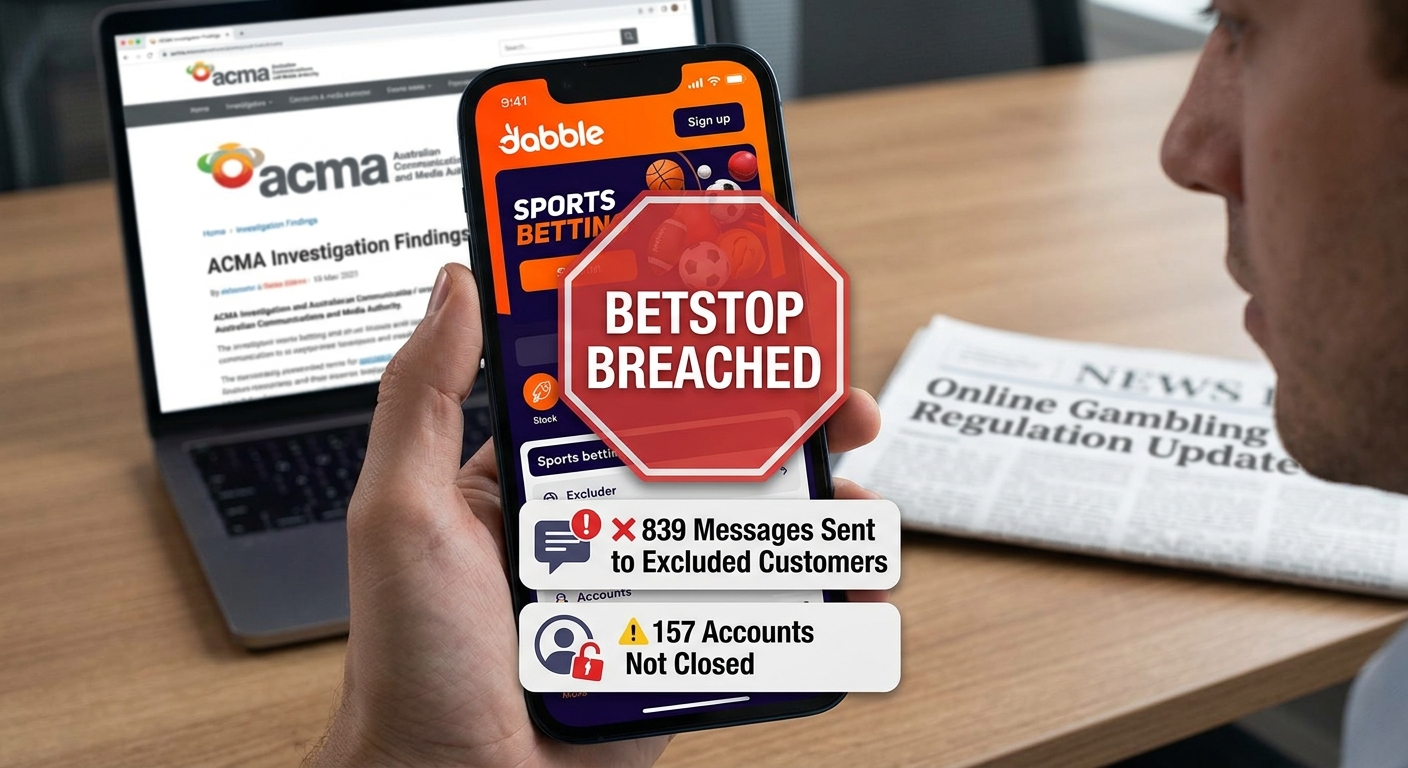
ACMA found that Dabble failed to close 157 wagering accounts after the account holders had registered with BetStop, Australia's National Self-Exclusion Register. The regulator also found that Dabble sent 165 self-excluded people a combined 839 electronic messages, including SMS, emails and app push notifications.
Alongside the financial penalties, Dabble has entered a two-year court-enforceable undertaking with ACMA. Under the undertaking, the company must commission an independent review of its compliance systems and invest in implementing the improvements recommended by that review.
What ACMA Found

ACMA found that Dabble failed to close 157 wagering accounts after the account holders had registered with BetStop. Under the current rules, wagering providers are required to close an account belonging to a person who has registered with BetStop as soon as practicable once the registration is identified, including returning any credit balance.
Separately, ACMA found that 165 people who were already excluded through BetStop received a total of 839 electronic messages from Dabble. The regulator also identified a further issue involving push notifications, finding that Dabble sent more than 2,000 push notifications to 45 customers without including information about BetStop that was required under the rules.
ACMA member Carolyn Lidgerwood said the findings were concerning and stressed the importance of effective self-exclusion controls. She said wagering providers must have robust systems in place to protect people who have chosen to self-exclude.
The findings cover separate aspects of BetStop compliance, including account closure, restrictions on electronic marketing and requirements concerning information provided to customers.
How BetStop Works
BetStop, formally known as the National Self-Exclusion Register, is Australia's national self-exclusion scheme for licensed online and telephone wagering services. It launched in August 2023 and allows a person to exclude themselves from all licensed online and phone wagering providers through a single registration rather than contacting individual operators separately.
Once a person registers with BetStop, participating wagering providers have obligations covering existing and prospective accounts and betting activity. These include closing an existing wagering account as soon as practicable, returning any account credit, refusing to open a new account or accept a bet from the person, and stopping electronic marketing or promotional communications to the excluded individual.
Providers must also include required BetStop information in relevant customer communications where the rules require it.
BetStop exclusion periods range from a minimum of three months to a lifetime exclusion. ACMA reported that 65,430 people had registered with BetStop as of 30 June 2026, including 40,160 people with an active exclusion at that date.
The register applies to licensed Australian online and telephone wagering services. It does not extend to land-based gambling venues or offshore operators that are not licensed to provide wagering services in Australia.
Dabble's Undertaking and Compliance Measures
In addition to the A$1,069,200 in penalties, ACMA has accepted a two-year court-enforceable undertaking from Dabble.
Under the undertaking, Dabble must commission an independent review of its compliance systems and implement the improvements recommended by that review. The undertaking is designed to require the operator to examine its systems and address identified compliance weaknesses.
ACMA said that if Dabble fails to comply with the undertaking, the regulator can apply to the courts to have its terms enforced.
The financial penalties and the court-enforceable undertaking are separate components of the regulatory action. The penalties address the breaches identified by ACMA, while the undertaking requires Dabble to undertake a formal review and implement resulting improvements.
What the A$1.07 Million Penalty Represents
ACMA said Dabble paid A$1,069,200 in penalties following the regulator's investigation. Reporting on the enforcement action identifies the penalties as infringement notice penalties.
The payment is separate from the two-year court-enforceable undertaking accepted by ACMA. The undertaking does not replace the financial penalties and instead requires Dabble to commission an independent compliance review and implement the improvements arising from that review.
The size of the payment reflects the scale of the regulatory action across several areas of BetStop compliance identified by ACMA, including account closures and electronic communications to self-excluded customers.
Australia's BetStop Penalties Increase From 1 January 2027
The Dabble enforcement action comes ahead of significant changes to Australia's BetStop framework. The Interactive Gambling Amendment (Gambling Reform) Act 2026 received Royal Assent on 26 August 2026, with the relevant BetStop amendments in Schedule 3 commencing on 1 January 2027.
Under the amended rules, wagering providers will be required to close a matched wagering account as soon as practicable and within seven days. Any credit balance held in the account must also be paid to the individual as soon as practicable.
The new legislation also changes the process for people seeking to deregister from BetStop. A deregistration application cannot be confirmed until at least seven days have passed, introducing a mandatory delay before the exclusion is ended.
The reforms also establish a mandatory minimum three-month exclusion period for people who repeatedly register for BetStop after previously deregistering.
Another significant change concerns electronic communications. The amended framework expressly covers communications sent through a device, application or software, including push notifications. This is particularly relevant to the Dabble case because ACMA's investigation identified more than 2,000 push notifications sent to 45 BetStop-excluded customers without the required BetStop information.
The legislation also substantially increases a range of BetStop-related penalties. For example, some existing provisions carrying penalties of 120 penalty units will increase to 500 penalty units from 1 January 2027, while some 180-penalty-unit provisions will increase to 750 penalty units.
These changes are prospective. They take effect from 1 January 2027 and do not change the penalties imposed on Dabble for the conduct examined by ACMA.
What Operators Need to Get Right
The Dabble case illustrates that BetStop compliance involves more than checking whether a customer is registered on the national exclusion register.
Australian wagering providers need systems capable of identifying BetStop registrations and closing matched wagering accounts within the applicable timeframe. They also need processes to ensure any credit balance is handled correctly following account closure.
Marketing suppression is another important part of compliance. Operators need to ensure that self-excluded customers are removed from electronic marketing across the channels through which communications can be delivered, including email, SMS and app-based notifications.
Operators also need to ensure that communications to customers contain required BetStop information where applicable. The expansion of the legislative framework to expressly cover application and device-based communications makes channel-level controls increasingly important.
Maintaining records of account matching, closure, marketing suppression and customer communications can also help operators demonstrate compliance if their systems are subsequently reviewed by ACMA.
This article is provided for general information and is not legal advice. Operators should consult ACMA guidance and the applicable legislation when assessing their specific compliance obligations.
Conclusion
The Dabble enforcement action shows that BetStop compliance extends across account closure, electronic marketing and customer communications. ACMA found that 157 wagering accounts remained open after their holders registered with BetStop, while 165 excluded people received a combined 839 electronic messages. The regulator also identified more than 2,000 push notifications sent to 45 customers without required BetStop information.
Dabble has paid A$1,069,200 in penalties and accepted a two-year court-enforceable undertaking requiring an independent review of its compliance systems and implementation of the resulting recommendations.
With further BetStop requirements and substantially higher penalties taking effect on 1 January 2027, Australian wagering providers will need to ensure their account-management, marketing-suppression and customer-communication systems are aligned with the amended framework.