- Breaking
- Developing
New York Sues Polymarket, Alleging Illegal Gambling Operation
New York Attorney General Letitia James sued Polymarket US on September 24, alleging its event contracts amount to unlicensed gambling. Polymarket disputes the claim and has moved the case to federal court.

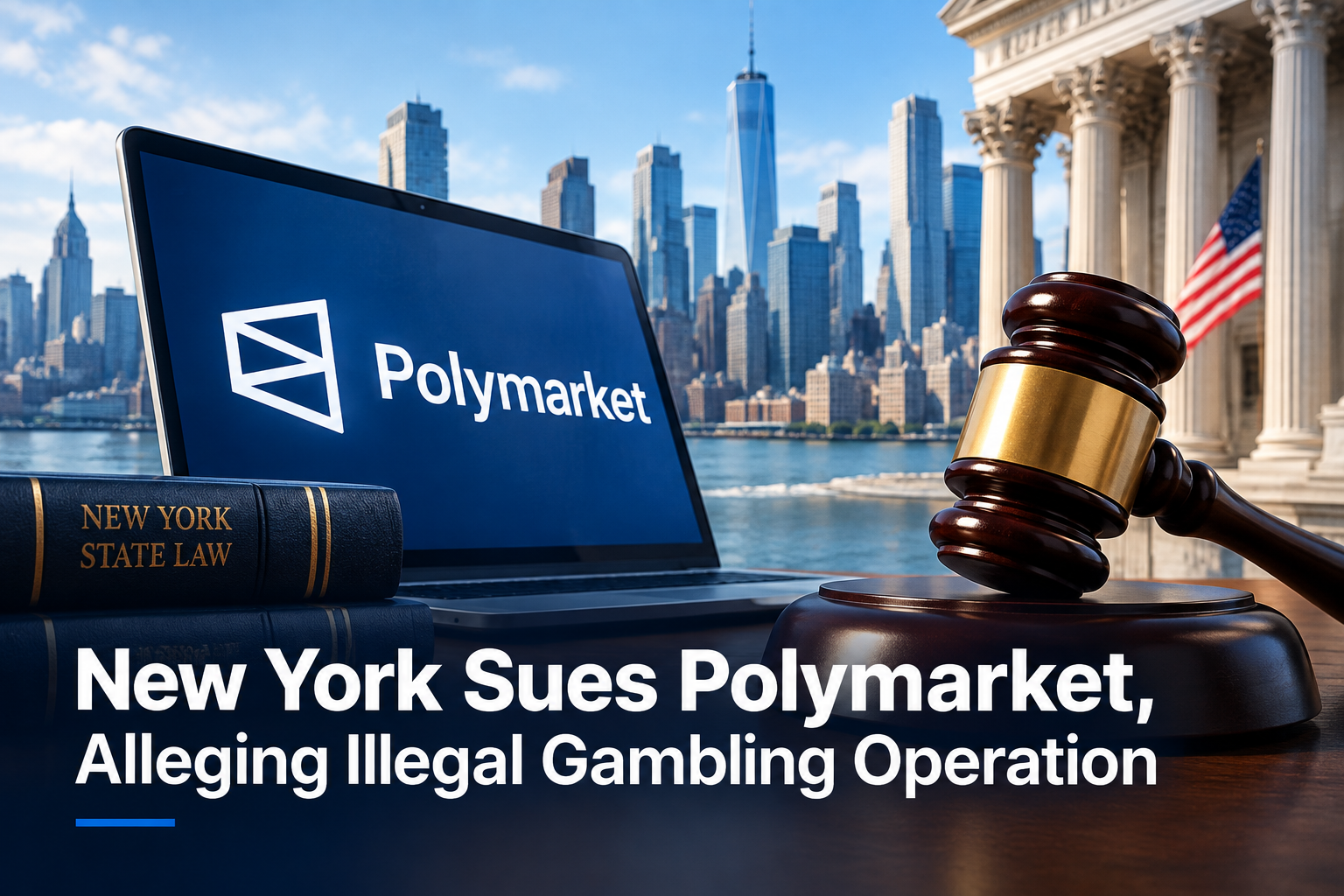
New York Attorney General Letitia James filed a lawsuit against QCX LLC, doing business as Polymarket US, on September 24, 2026, alleging that the company has been running an unlicensed, illegal gambling operation in New York through its prediction-market platform. The lawsuit was announced jointly by James and Governor Kathy Hochul.
According to the Attorney General's office, an investigation by the Office of the Attorney General (OAG) concluded that Polymarket's prediction markets meet New York's legal definition of gambling because the outcomes users bet on are uncertain and outside the bettor's control. The state alleges Polymarket has never obtained a license from the New York State Gaming Commission, and that this allows the company to avoid the tax obligations imposed on licensed casinos and mobile sports-wagering platforms.
The state also alleges that Polymarket's platform is accessible to users between the ages of 18 and 20, despite a New York requirement that a person be at least 21 years old to participate in mobile sports betting. "By running an unlicensed gambling operation, Polymarket has done more than just knowingly violate state law, they have put New Yorkers at risk, especially those underage who are most vulnerable to problem gaming," Governor Hochul said in the joint announcement. Attorney General James said the company is "targeting the most vulnerable and depriving New York families of critical services and support."
What New York Is Seeking

The petition, filed in New York state court in Manhattan, asks a court to order Polymarket to stop operating as an unlicensed gambling business in the state. Beyond an injunction, the Attorney General is seeking forfeiture of what the state characterizes as illegal gains, restitution for affected New York consumers, and civil penalties equal to three times those gains.
These are allegations contained in a civil enforcement petition, not findings made by a court. No judge has yet ruled on the merits of New York's claims, and Polymarket disputes them.
Polymarket's Response
Polymarket Chief Legal Officer Neal Kumar said in a statement that the company "chose to engage with them directly on the substance and address their concerns," adding that the company's "door is open for a conversation about how we protect consumers and offer fair, transparent and legal markets." The company has said it intends to fight the case.
Procedurally, Polymarket moved on the same day to remove the case from New York state court to the U.S. District Court for the Southern District of New York, a federal court, and separately filed its own civil suit against Attorney General James and officials of the New York State Gaming Commission. Those filings reflect the company's position that its event contracts are financial products that fall under federal, not state, jurisdiction — a position it shares with other prediction-market operators. As of this report, neither the state court petition nor Polymarket's countersuit had been ruled on.
Part of a Broader Pattern of New York Enforcement
Thursday's filing is not New York's first action against a prediction-market or crypto-adjacent platform. In July 2026, James and Hochul announced a similar lawsuit against Kalshi, alleging it was running an illegal gambling platform under the same New York gambling-law theory now applied to Polymarket. In April 2026, James sued Coinbase and Gemini over what her office described as illegal gambling platforms, and Hochul signed an executive order that same month barring state employees from using prediction markets such as Polymarket for personal trading. In January 2026, James sued video-game developer Valve over allegations it illegally promoted gambling to minors through its platform. In September 2026, separately from the Polymarket case, James secured an $8 million settlement from the operator of a leading sweepstakes-casino platform.
A Wider Regulatory Fight Over Prediction Markets
The Polymarket suit lands inside a larger, unresolved conflict over who has authority to regulate prediction markets in the United States. Prediction-market operators, including Polymarket and Kalshi, argue their event contracts are derivatives regulated federally by the Commodity Futures Trading Commission, not gambling products subject to individual state licensing regimes. The CFTC has taken the same position in separate litigation this year against states seeking to impose their own rules on these platforms, arguing that a state-by-state "patchwork" of regulation increases fraud risk and undermines consumer protection at a national level. New York's position — reflected in both the Kalshi and Polymarket suits — is that state gambling law applies regardless of how a platform's contracts are structured or which federal agency licenses the underlying exchange.
What Happens Next
The immediate procedural question is which court — the New York state court where James filed, or the federal court to which Polymarket has moved the case — will ultimately hear the dispute. No hearing date, briefing schedule, or ruling had been reported as of this writing. Level.casino will update this story as the litigation, and the parallel Kalshi case it closely tracks, develop.
Timeline
- January 2026 — Attorney General James sues Valve over alleged illegal gambling promotion aimed at minors.
- April 2026 — James sues Coinbase and Gemini over alleged illegal gambling platforms; Governor Hochul signs an executive order barring state employees from personal use of prediction markets.
- July 2026 — James and Hochul announce a lawsuit against Kalshi on the same legal theory later applied to Polymarket.
- September 2026 (early) — James secures an $8 million settlement from a leading sweepstakes-casino operator.
- September 24, 2026 — James and Hochul announce the lawsuit against QCX LLC d/b/a Polymarket US; Polymarket moves to remove the case to federal court and files its own suit against James and New York State Gaming Commission officials the same day.
Reporting & Methodology
Based on the joint announcement issued by the Office of Governor Kathy Hochul and the New York Attorney General on September 24, 2026, supplemented by contemporaneous reporting on the filing, Polymarket’s response, its same-day removal request and countersuit. Historical enforcement actions mentioned in the article should be supported by their respective primary sources where available. No court has ruled on the merits of the competing claims as of publication; disputed allegations are attributed to the parties.