- Developing
Ohio Orders 10 Prediction-Market Platforms to Stop Offering Sports Contracts
Ohio’s casino regulator sent 10 letters dated 2 October 2026 telling prediction-market platforms and brokers to stop offering sports event contracts in the state. Compliance is due by 16 October.

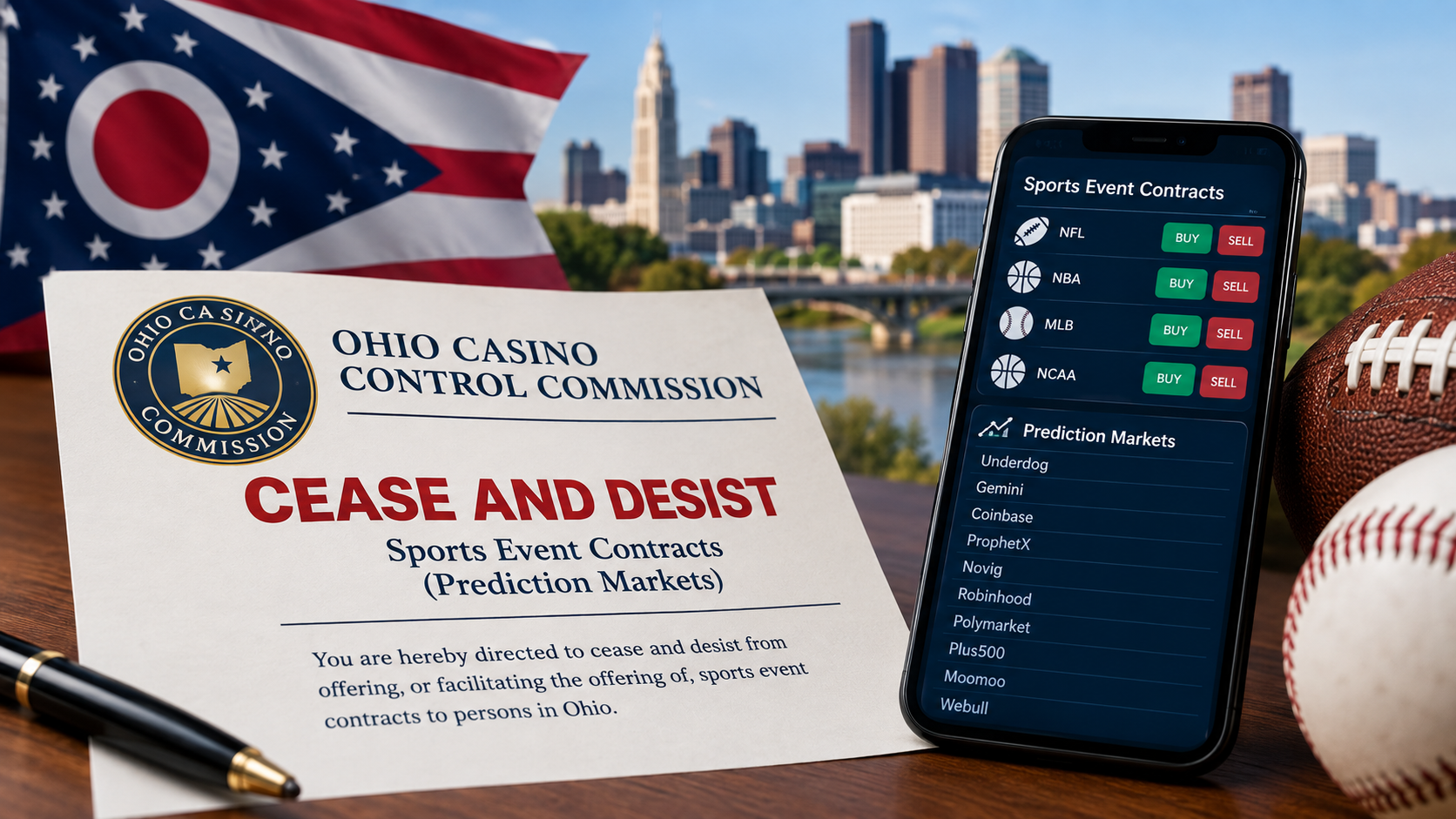
The Ohio Casino Control Commission has sent cease-and-desist letters to 10 prediction-market platforms and brokers, demanding that they stop offering, or facilitating the offering of, sports event contracts to people in Ohio. The letters are dated 2 October 2026, not 6 October. Each gives its recipient 14 days, until 16 October, to confirm in writing that it has complied. The Commission’s position is that the contracts are unlicensed sports gaming under Ohio law.
Who received the letters

The Commission’s combined set of letters is addressed to:
- UDM, LLC d/b/a Underdog Predict and Underdog Exchange DCM, Inc.
- Gemini Titan, LLC
- Coinbase, Inc.
- Prophet X
- Novig Betting, Inc. and Ludlow Exchange, LLC
- Robinhood Derivatives, LLC
- PM US Tech (QC Tech LLC), which the letter refers to as Polymarket
- Plus500US Financial Services, LLC
- Moomoo Financial Inc.
- Webull Financial LLC
The Robinhood letter, addressed to its outside counsel, reasserts a notice the Commission first issued to Robinhood on 31 March 2025. The other nine letters are framed as new notices. Kalshi is not among the recipients. The letters are signed by Andromeda Morrison, the Commission’s interim executive director, and were sent by certified mail, email or both.
What the Commission alleges
Each letter says the recipient is offering “event contracts” on sporting events to people in Ohio without a sports gaming licence. It describes such a contract as one that reflects which team a person believes will win, or whether a team or player will meet certain statistics, with money won or lost on the result. “Plainly stated,” the letters say, the recipient “is operating online sports gaming.”
The letters cite Ohio Revised Code section 3775.03(A), which requires a Commission licence to offer sports gaming, and say that operating sports gaming outside Chapter 3775 is a felony under section 3775.99(B)(9). They also say unlicensed sports gaming amounts to bookmaking or facilitating bookmaking under Chapter 2915 of the Criminal Code, and that each recipient’s online content, including its website, is a nuisance that can be abated under Chapter 3767. These are the Commission’s positions in the letters, not findings by a court.
What the recipients are told to do
Each recipient must cease and desist from offering, participating in offering, or facilitating those who offer sports event contracts in Ohio. The letters say this includes soliciting or accepting orders for sports event contracts listed on designated contract markets from people in Ohio, and operating a futures commission merchant or designated contract market that offers them to people in Ohio. That wording reaches brokers and apps that route customers to exchanges run by others.
A recipient that does not comply may face administrative, civil, nuisance or criminal action, the letters say. The Commission also says it can impose a civil penalty or fine, including an amount equal to the money or value of property obtained by offering the contracts to people in Ohio, and may pursue officers, directors and parent companies.
The court ruling behind the letters
The Commission relies on the 25 September 2026 decision of the U.S. Court of Appeals for the Sixth Circuit in KalshiEX LLC v. Schuler, No. 26-3196, together with the related Tennessee appeal in No. 26-5235. The court held that Kalshi’s sports-event contracts did not qualify as “swaps” under the Commodity Exchange Act and therefore did not fall within the CFTC’s exclusive jurisdiction. The court also held, alternatively, that the CEA did not expressly or impliedly preempt Ohio’s sports-gaming laws.
The Sixth Circuit affirmed the Southern District of Ohio’s denial of Kalshi’s request for a preliminary injunction. In the related Tennessee appeal, it vacated the preliminary injunction and remanded for further proceedings. The Ohio Commission’s October letters rely on the Ohio ruling as the basis for proceeding with enforcement.
What is still open
The letters specifically address sports event contracts; they do not purport to address other categories of event contracts. We found no public response from any recipient and no indication that any has challenged the letters. Whether companies withdraw from Ohio, restrict access or contest the Commission will become clearer after the 16 October deadline. Courts elsewhere have been asked the same preemption question, and this report covers only Ohio’s letters.
Reporting & Methodology
This report is based on the Ohio Casino Control Commission’s ten cease-and-desist letters dated 2 October 2026, read in full from a copy of the combined PDF hosted by AVC News. The U.S. Court of Appeals for the Sixth Circuit’s published opinion and judgment in KalshiEX LLC v. Schuler, Nos. 26-3196/5235, filed on 25 September 2026, was reviewed directly for the legal characterization and disposition of the court proceedings. AVC News, which relayed the Commission’s statement on 3 October, and RG.org were used for corroboration. We did not review any recipient response or later administrative or court filing concerning the October letters. Statutory allegations and the Commission’s interpretation of Ohio law are attributed to the Commission. Dates were checked against the letters rather than against the dates of news coverage.
More from Regulation
- Brazil: Lula Re-Elected as Congress Considers Fixed-Odds Betting Ban
- UK Budget Preview: Gambling Duties and the Machine Games Duty Debate Before 28 October
- AGCO Fines theScore.Bet C$200,000 Over Cash-Out Offers It Did Not Honour
- Brazil’s Licensed Betting Sites Reach Shutdown Date as Fixed-Odds Ban Takes Effect