Ontario iGaming Hits CA$9.9B Wagering Record as Online Casino Drives Growth
Ontario's regulated iGaming market set a record with CA$9.9 billion in cash wagers in July 2026. Online casino accounted for roughly 89% of activity, highlighting its growing role as the foundation of the province's regulated commercial iGaming market.

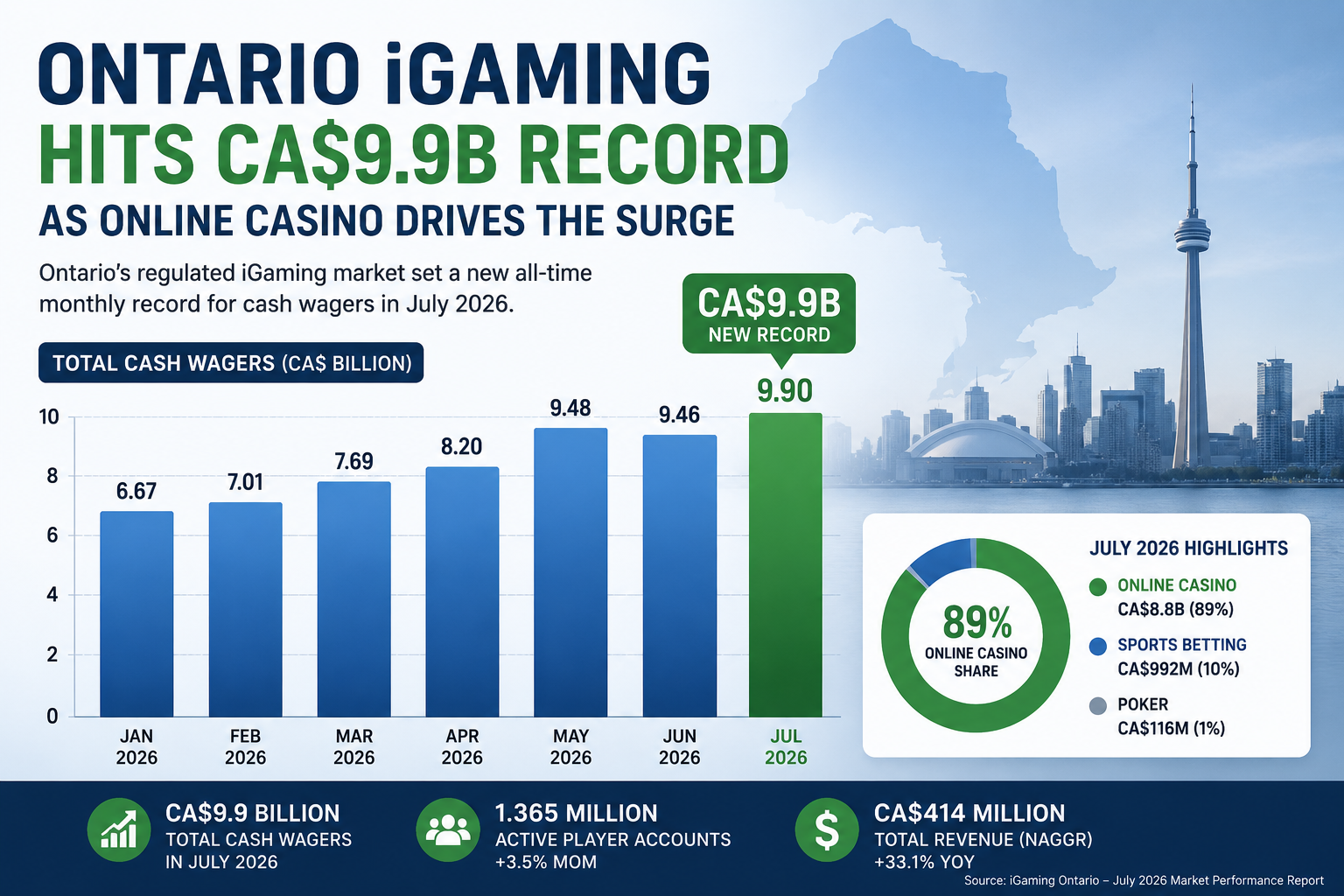
Ontario's regulated online gambling market posted its strongest month since launching in 2022, with iGaming Ontario reporting CA$9.9 billion in total cash wagers for July 2026. It's the highest monthly handle the province has recorded, and it arrived not through a sports-betting spike but through the steady, year-round pull of online casino products, which accounted for roughly 89% of everything wagered during the month.
That distinction matters. A record built on casino play tends to reflect something more durable than a record built around a single tournament or event — it points to a market whose growth engine runs every day of the year rather than one that surges and cools with the sports calendar. July's numbers offer a useful window into how much of Ontario's regulated iGaming economy now rests on that foundation.
Ontario Sets a New Monthly iGaming Wagering Record

According to iGaming Ontario's official figures, cash wagers across the province's regulated market reached CA$9.9 billion in July, a 30.7% increase over the same month in 2025. That surpassed the previous high of roughly CA$9.48 billion, set in May 2026 — June had actually dipped slightly to about CA$9.46 billion before July's jump pushed the market to a new peak, an increase of close to 4.7% month over month.
It's worth being precise about what this figure represents. Cash wagers, sometimes called "handle," is the total amount of money bet by players — not money won or lost, and not operator revenue. Because winnings are frequently rewagered, the same dollar can be counted multiple times within a single month's handle. A CA$9.9 billion wagering total does not mean players lost anywhere close to that amount, and it doesn't represent what operators earned either.
That's a separate figure: non-adjusted gross gaming revenue, or NAGGR — total wagers and fees minus what was paid back to players in winnings, before any operating costs. In July, NAGGR reached CA$414 million, up 33.1% year over year. That's a strong number, but it's worth noting it was not itself an all-time high: Ontario's NAGGR peaked in December 2025 at CA$426 million, meaning July's result was the second-best month on record for revenue, even as wagering hit a new ceiling.
Online Casino Generated the Majority of Ontario's Activity
The clearest story in July's numbers is the scale of online casino's dominance. Casino products — slots, live dealer games, and computer-based table games — generated CA$8.8 billion in wagers, or about 89% of the province's total handle, up 30.2% from July 2025. On the revenue side, online casino produced roughly CA$330 million in NAGGR, about 80% of the market's total, a 31% year-over-year increase.
Sports betting, by comparison, accounted for a much smaller share of wagering — CA$992 million, or roughly 10% of total handle — despite posting the fastest year-over-year growth rate of any vertical at 44.2%. Sports betting revenue reached CA$78 million, up 47.2% annually, and represented about 19% of total NAGGR. That's a reminder that sports betting, while a smaller slice of overall handle, tends to punch above its weight on the revenue side relative to its wagering share.
Peer-to-peer poker remained the smallest vertical by a wide margin: CA$116 million in wagers, about 1% of the market, down 16.5% year over year, with NAGGR of CA$5.3 million, also roughly 1% of the total and down 10.2% annually.
The structural point here is straightforward: nearly nine of every ten dollars wagered in Ontario's regulated market in July went into casino-style products. Unlike sports betting, which depends heavily on the calendar of major leagues and tournaments, online casino activity is available and popular year-round — which helps explain why Ontario could set a wagering record in July, traditionally a quieter stretch for North American sports leagues.
Revenue and Player Activity Also Show Market Expansion
Active player accounts climbed to 1,365,000 in July, up from June's 1.319 million — a month-over-month increase of roughly 3.5%, and a substantial year-over-year jump. Average revenue per active account came in at CA$303, down 7.6% from a year earlier, which suggests the growth in accounts is outpacing growth in average spend per account — consistent with an expanding, rather than simply more intensely monetized, player base.
One caveat is essential here: active player accounts are not the same as unique individuals. A single person can — and frequently does — hold accounts with multiple licensed operators, so 1.365 million active accounts does not mean 1.365 million distinct Ontarians gambled online in July. iGaming Ontario does not publish a unique-player figure, so account counts remain the best available proxy, but should be read as an upper bound on participation rather than a precise headcount.
Why Ontario's Market Reached CA$9.9 Billion
Separating what's confirmed from what's interpretation matters here. What's clear from the data: Ontario's regulated market has been on a sustained growth trajectory since its 2022 launch, online casino has consistently been — and remains — the dominant vertical by both wagers and revenue, and active account growth suggests the market is still adding participants rather than simply extracting more from the same base.
What's plausible but not proven by this data alone: that a relatively quiet mid-summer sports calendar allowed casino spending to stand out more starkly than usual, or that continued marketing and product investment by operators played a role. iGaming Ontario's report does not isolate a single cause for the July record, and this article does not claim one. Multiple factors — a maturing operator ecosystem, growing account numbers, and casino's structural year-round appeal — appear to have moved together.
Ontario's Record in Historical Context
Ontario opened its competitive, regulated iGaming market on April 4, 2022, becoming the first Canadian province to allow private operators to offer online casino and sports betting under a commercial licensing framework overseen by the Alcohol and Gaming Commission of Ontario (AGCO), with iGaming Ontario (iGO) managing operator agreements and reporting.
The market has grown substantially since. In its third full year of operation (fiscal 2024-25), Ontario's regulated operators recorded CA$82.7 billion in total wagers, a 31% increase over the prior year, and CA$3.2 billion in gross gaming revenue, up 32%. Casino games alone generated CA$69.6 billion of that wagering total and CA$2.4 billion of revenue — already the dominant category. At the time, iGaming Ontario reported 49 operators running 84 gaming sites; the current count for mid-2026 was not independently confirmed for this article and may have shifted since.
Regulatory oversight has continued alongside this growth. In August 2026, the AGCO issued a CA$70,000 penalty against gaming developer Booming Games after finding it had used a prohibited auto-play feature in its games — a reminder that Ontario's expansion has come with active enforcement, not just rising volume.
What Ontario's Record Means for North American iGaming
Ontario's structure — a single province offering both online casino and sports betting under one competitive licensing regime — differs meaningfully from the patchwork approach in the United States, where online casino access remains limited to a handful of states and sports betting and iCasino are frequently regulated separately. Ontario's experience could offer a useful case study for other Canadian provinces weighing similar frameworks, and for policymakers elsewhere assessing what a mature, casino-led regulated market looks like in practice. It should be read as one data point rather than a template that other jurisdictions will necessarily follow — Ontario's results reflect its own regulatory choices, population, and competitive landscape.
The Numbers Behind the Record
| Metric | July 2026 | YoY Change |
|---|---|---|
| Total cash wagers | CA$9.9 billion | +30.7% |
| Total NAGGR | CA$414 million | +33.1% |
| Active player accounts | 1,365,000 | Up substantially YoY |
| Average revenue per active account | CA$303 | -7.6% |
| Online casino wagers | CA$8.8 billion (~89% share) | +30.2% |
| Online casino NAGGR | CA$330 million (~80% share) | +31% |
| Sports betting wagers | CA$992 million (~10% share) | +44.2% |
| Sports betting NAGGR | CA$78 million (~19% share) | +47.2% |
| Poker wagers | CA$116 million (~1% share) | -16.5% |
| Poker NAGGR | CA$5.3 million (~1% share) | -10.2% |
Important Context Behind Ontario's CA$9.9 Billion Figure
- Wagers are not player losses. CA$9.9 billion is total turnover, including rewagered winnings — not the amount players lost or spent.
- Revenue is a different number entirely. Operators' actual gross gaming revenue for the month was CA$414 million, a fraction of the wagering total.
- July's NAGGR was not a record. It was the second-highest monthly figure on record, behind December 2025's CA$426 million.
- The figures are unaudited. iGaming Ontario explicitly notes that monthly statistics are operational figures subject to later adjustment.
- Reporting scope is limited. iGO's figures cover only operators under commercial agreement with the agency and exclude both the government-run OLG.ca platform and pari-mutuel horse racing, so they don't capture the entirety of Ontario's online gambling activity.
- Active accounts are not unique players. A single individual can hold accounts with several operators, so the account total is an upper bound on participation, not a headcount.
Conclusion
The headline number — CA$9.9 billion in a single month — is the easy story. The more durable one is what sits underneath it: an iGaming market where online casino products now generate close to nine of every ten dollars wagered, growing steadily whether or not a major sporting event is on the calendar. Ontario's July result adds another data point to a pattern that has held since the market's earliest years — casino, not sports betting, is what has carried this market to its current scale, and it's likely to remain the metric worth watching as Ontario's regulated iGaming sector continues to mature.