- Developing
Germany's GGL Calls for Greater Flexibility to Tackle Illegal Online Gambling
Germany's GGL marked five years of operation on 22 September 2026 by calling for more flexibility to adjust its enforcement approach against illegal online gambling, arguing the treaty-amendment process behind its powers is too slow for a fast-changing market.

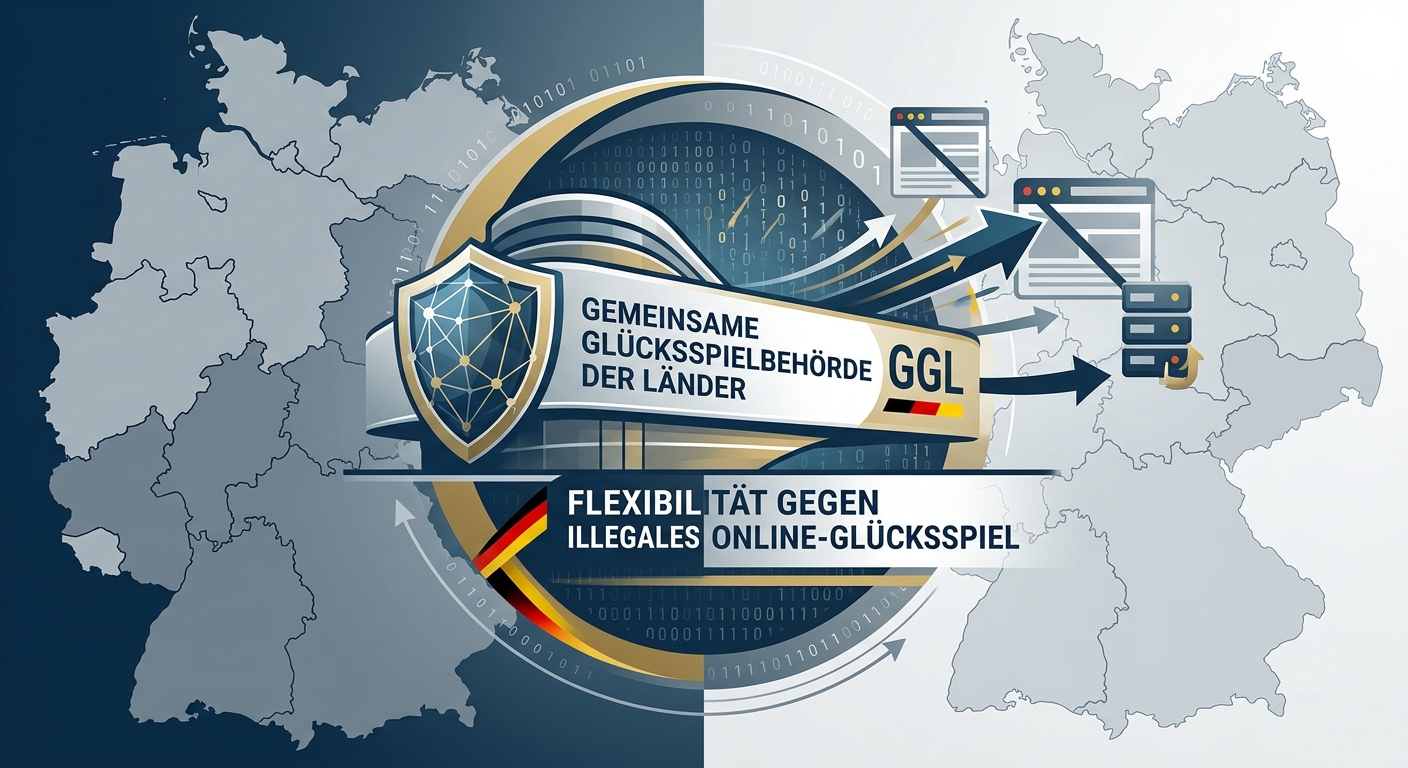
GGL Calls for Greater Flexibility Against Illegal Online Gambling

Germany's central gambling regulator, the Gemeinsame Glücksspielbehörde der Länder (GGL), marked five years of operation on 22 September 2026 by arguing that the legal framework behind its enforcement powers is too slow to keep pace with a fast-changing illegal online gambling market. In a press release published the same day, and in a separate interview with the regional newspaper Mitteldeutsche Zeitung, GGL board member Ronald Benter said the authority wants the currently ongoing evaluation of Germany's Glücksspielstaatsvertrag 2021 (GlüStV 2021, the Interstate Treaty on Gambling) to give it more day-to-day flexibility to adjust its enforcement approach, rather than requiring a full treaty amendment for every adjustment.
"The illegal market is very dynamic," Benter told Mitteldeutsche Zeitung. "That is why we, as an authority, also have to become faster." He argued that even where the GGL and Germany's 16 federal states agree changes are needed, amending the treaty can take several years, because it requires the consent of all 16 states plus ratification by each state parliament.
The GGL's own framing is narrower than the "greater powers" shorthand used in some headlines. Its press release speaks of gaining more "fachlicher Handlungsspielraum" — professional or operational latitude within the existing legal framework, exercised under continued oversight of its Verwaltungsrat, the administrative council through which the 16 states are represented — rather than describing a specific new enforcement tool it currently lacks.
What the GGL Is Asking For
Two distinct requests emerge from the GGL's statements. First, the authority wants the ongoing evaluation of GlüStV 2021 — due to conclude with a states' final report by the end of 2026 — to result in a governance change that lets the GGL adjust its enforcement approach more quickly, with its Verwaltungsrat retaining oversight, instead of each adjustment requiring a formal treaty amendment. Benter said the GGL has the in-house expertise to react faster to market developments if given that latitude.
Second, in the Mitteldeutsche Zeitung interview, Benter separately called on public prosecutors to bring more criminal cases against individuals based outside Germany who offer illegal gambling to German customers. He said such prosecutions "have so far happened almost never," and that the GGL believes more of them could act as a deterrent. This is a call for greater use of existing criminal law by prosecutors, not a request for the GGL itself to gain new criminal-enforcement authority.
Neither statement reviewed for this article describes a request for a specific new technical enforcement mechanism, such as a new blocking power, that the GGL does not already hold.
Germany's Existing Enforcement Framework
The GGL has held responsibility for combating illegal online gambling — including prohibition orders, network/IP blocking and payment blocking — since 1 July 2022, a year before it took on full licensing and supervisory authority over the legal market on 1 January 2023. Since September 2024, only GGL-licensed operators have been permitted to advertise gambling via Google Ads in Germany, an example of the authority extending enforcement to intermediaries rather than acting only against individual illegal sites.
The GGL's five-year review describes an enforcement approach that increasingly targets the ecosystem around illegal operators — payment providers, advertising partners, affiliate networks and hosting services — rather than individual websites alone. Cross-border cooperation is also expanding: regulators from Germany, Austria, Switzerland and Liechtenstein met in Bern on 9–10 September 2026 and agreed to share more information on operators, enablers and emerging business models across jurisdictions.
Why Illegal Online Gambling Remains a Challenge
According to the GGL's five-year figures, prohibition proceedings rose from 68 in 2022 to 287 in 2025 — more than a fourfold increase — with roughly 700 initiated in total and around 6,300 websites reviewed for illegal gambling offers or related advertising since the authority began operating. By the end of 2025, the GGL said, 1,843 illegal websites were no longer reachable from Germany as a result of prohibition orders or network blocking, 254 operators behind those sites had stopped serving the German market, and 178 illegal websites had been cut off from mainstream payment channels.
The GGL also cites a commissioned channelisation study putting roughly 77% of Germany's online gambling market within the licensed sector — an estimate, not a measured administrative count, and one the authority says leaves a "not insignificant" share of the market still outside regulation. Separately, prosecutors in Frankfurt disclosed a case, welcomed by the GGL in a 17 September 2026 statement, involving alleged illegal gambling operations that processed an estimated €5.86 billion between July 2021 and the end of 2023, with a suspected 2024 tax loss of €77.6 million and €82 million in assets secured; that figure describes one law-enforcement case rather than the market as a whole.
Legal and Regulatory Context
GlüStV 2021 re-regulated Germany's gambling market from 1 July 2021, creating a single national licensing gateway for online sports betting, online poker and virtual slot machine games, among other products. The GGL was established the same day as an Anstalt öffentlichen Rechts — a public-law institution jointly owned by the 16 federal states — headquartered in Halle (Saale), and now employs around 100 people. As of September 2026, 129 operators and intermediaries hold a GGL licence, covering 229 authorised websites; more than 600 supervisory checks were carried out on licensed operators in 2025, and two licences have been revoked since the authority's creation.
The treaty's evaluation process is already under way and was not initiated by these September statements: an interim report was presented in spring 2024, and a final report from the states is due by the end of 2026. The GGL says it is using that existing process, rather than proposing a separate legislative initiative, to make its case for more flexibility.
What Greater Flexibility Could Mean
Confirmed from the GGL's own statements: it wants the evaluation to result in the Verwaltungsrat, rather than the full treaty-amendment process, being able to sign off on adjustments to how the authority enforces the rules. Existing legal mechanism: the GGL already has prohibition, network-blocking and payment-blocking powers, in use since 2022. Possible implication reported by industry press but not confirmed in GGL's own statements: some trade coverage summarised this loosely as the GGL seeking "greater powers" in general terms; one outlet, SiGMA, explicitly noted the GGL's statement "does not announce any new regulatory powers." This article follows the more precise, primary-source reading.
What Happens Next
No new legislation or treaty amendment has been proposed or adopted as a direct result of these September 2026 statements. The GGL's request depends on the outcome of the states' ongoing GlüStV 2021 evaluation, whose final report is due by the end of 2026; any change to how the treaty is administered would follow a political process on a timetable not yet confirmed. No operator, trade association or political figure had issued a public response specifically to the GGL's 22 September statements as of publication, though German trade bodies including the Deutscher Sportwettenverband and Deutscher Online Casinoverband have separately and consistently argued for stronger black-market enforcement as part of the same evaluation process.
Timeline
- 1 July 2021 — Germany's Glücksspielstaatsvertrag 2021 takes effect and the GGL is established.
- 1 July 2022 — GGL assumes enforcement responsibility for illegal online gambling, including IP and payment blocking.
- 1 January 2023 — GGL takes on full licensing and supervisory authority for the legal market.
- September 2024 — Only GGL-licensed operators permitted to advertise via Google Ads in Germany.
- 9–10 September 2026 — DACHL regulators (Germany, Austria, Switzerland, Liechtenstein) meet in Bern to strengthen cross-border cooperation.
- 17 September 2026 — GGL welcomes a Frankfurt prosecutors' action against an alleged illegal-gambling network.
- 22 September 2026 — GGL publishes its five-year review and calls for more flexibility; Mitteldeutsche Zeitung publishes its Benter interview.
- 23 September 2026 — International trade press reports the story.
Bottom Line
The GGL's five-year statement is best read as a regulator arguing its existing tools work, while asking for a faster, treaty-evaluation-based route to adjust how it uses them — plus a separate push for prosecutors to bring more criminal cases against foreign-based illegal operators. It is not, on the record reviewed here, a request for a specific new enforcement power the GGL does not already hold, and no legislative change has yet been proposed or adopted.
| Fact box | |
|---|---|
| Regulator | Gemeinsame Glücksspielbehörde der Länder (GGL) |
| Country | Germany |
| Issue | Illegal online gambling enforcement |
| Regulatory framework | Glücksspielstaatsvertrag 2021 (currently under evaluation) |
| Category | Regulation |
| Status | GGL requesting more operational flexibility via ongoing treaty evaluation; final states' report due end-2026 |
Reporting & Methodology
This article is based primarily on the Gemeinsame Glücksspielbehörde der Länder (GGL)'s own 22 September 2026 press release marking its fifth anniversary, cross-checked against GGL's published historical record of its enforcement powers and its evaluation-process communications, and against Ronald Benter's 22 September 2026 interview with Mitteldeutsche Zeitung as syndicated by dpa-AFX/dts and reported in English by Casino Guardian and other outlets. Figures on GGL enforcement activity (prohibition proceedings, blocked websites, payment blocking, licensing) are taken directly from GGL's own five-year statistical review. The 77% channelisation figure is attributed to GGL's commissioned study and reported as an estimate, not a measured count. Figures on the separate Frankfurt prosecutors' case are attributed to that case specifically and are not conflated with GGL's market-wide statistics. Requested powers are attributed to the GGL and Ronald Benter and are not characterised as adopted legislation.
More from Regulation
- Brazil: Lula Re-Elected as Congress Considers Fixed-Odds Betting Ban
- UK Budget Preview: Gambling Duties and the Machine Games Duty Debate Before 28 October
- Ohio Orders 10 Prediction-Market Platforms to Stop Offering Sports Contracts
- AGCO Fines theScore.Bet C$200,000 Over Cash-Out Offers It Did Not Honour