- Breaking
- Developing
Malta's New Gaming Tax and VAT Rules Take Effect October 1
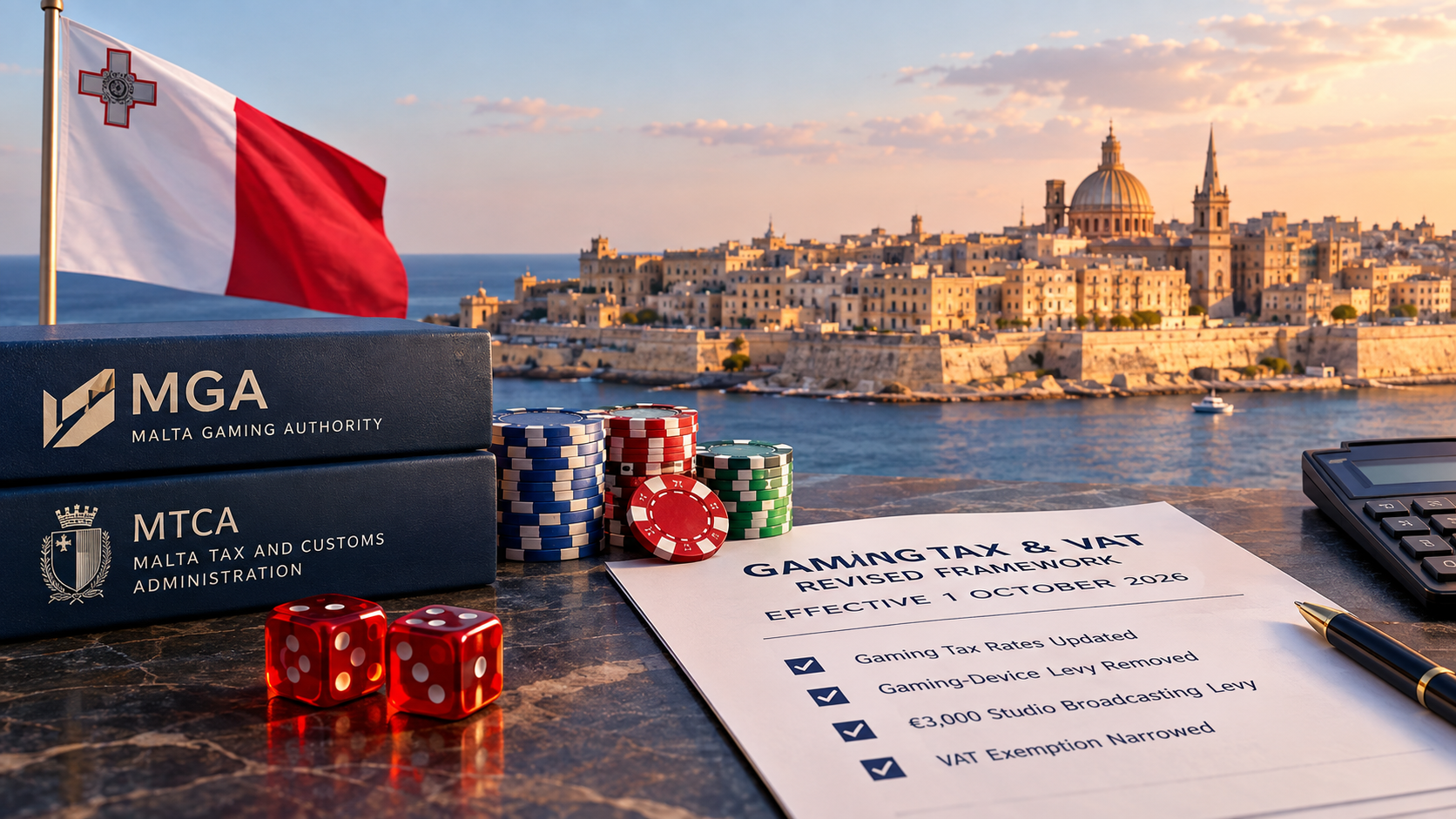
Malta's gaming tax and VAT rules for the gambling sector change on October 1, 2026, replacing a flat 5% gaming tax with rates differentiated by game type and narrowing the VAT exemption for gambling to three specific categories.

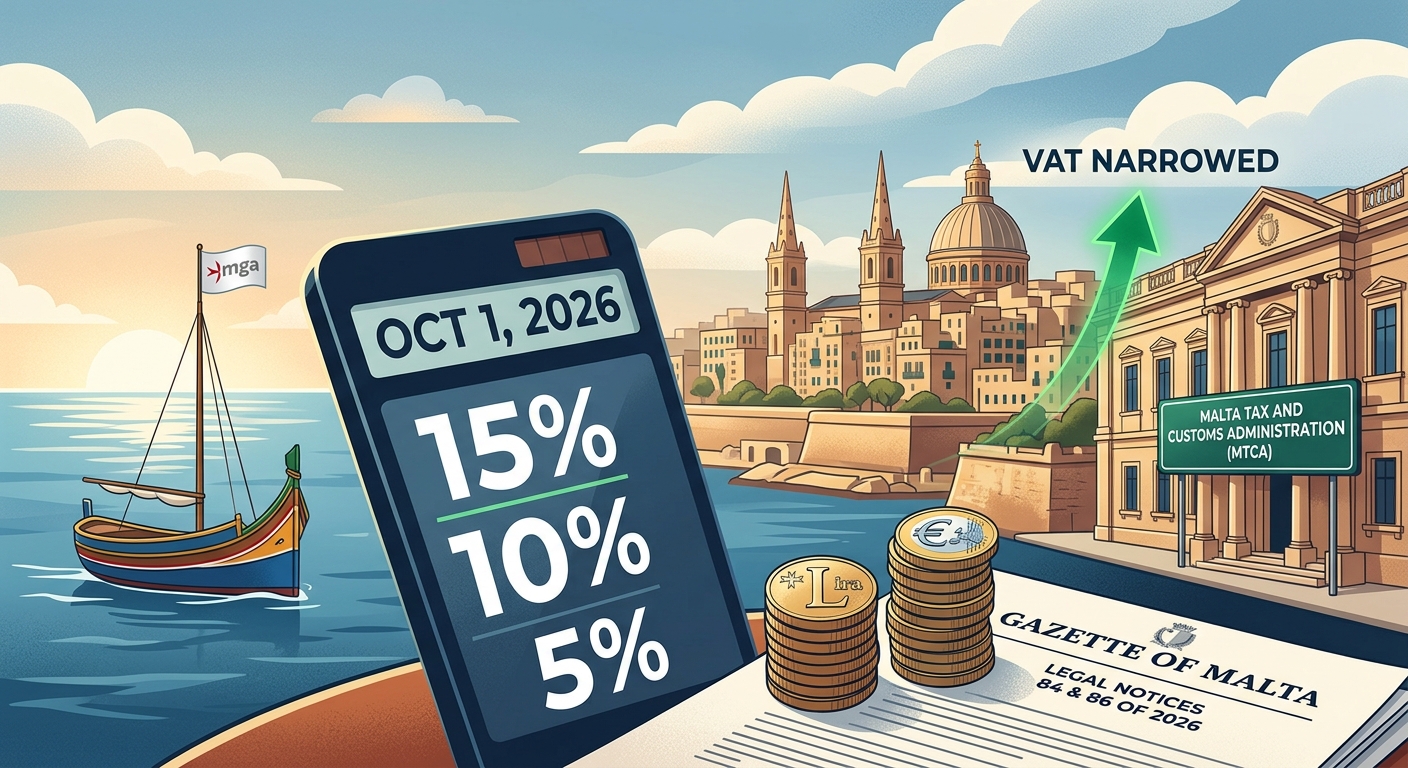
Malta's gambling industry moves onto a new tax footing on October 1, 2026, when two coordinated legal instruments take effect: a restructured gaming tax and a narrower VAT exemption for gambling supplies. Both changes stem from legal notices published on April 1, 2026, and were announced jointly by the Malta Gaming Authority (MGA) and the Malta Tax and Customs Administration (MTCA) the following day, as part of measures linked to Malta's 2026 Budget.
What Changes in Gaming Tax

Until September 30, 2026, Malta applied a flat 5% gaming tax on qualifying gaming revenue, alongside a separate levy tied to gaming devices. The Gaming Tax (Amendment) Regulations, 2026 — issued under the Gaming Act and detailed in a technical analysis published by PwC Malta — replace that flat rate with a structure tied to Malta's existing licensing categories, known as Type 1 through Type 4.
Type 1 covers games of chance played against the house, such as roulette, blackjack and RNG-based casino games; these move to a 15% rate. Type 2 (sports and event betting), Type 3 (player-versus-player games such as poker and bingo, where the operator earns a commission rather than bearing gaming risk) and Type 4 (controlled skill games) all move to 10%. A reduced 5% rate is preserved, but only for activity generated within controlled gaming premises or classified as a lawful junket event.
The device-based levy is abolished entirely. In its place, a new fixed levy of €3,000 per year — up from a previous €500 — applies to anyone authorised to provide a "critical gaming supply" who operates a studio to film or broadcast gaming content, payable in advance for the following twelve months. Gaming tax will now be computed monthly, at the close of each reference month, and licensed corporate groups continue to be treated as a single taxable "person," consistent with prior practice.
Excess tax payments remain non-refundable and non-interest-bearing, but operators' ability to use them has narrowed: they may now only be set off against gaming tax due in later periods, rather than under the broader set-off rules that applied before. The MGA's power to grant reliefs — reductions, credits or set-offs — has also been reframed, allowing the Authority to act by binding instrument, including under international arrangements, without the ministerial approval previously required.
What Changes in VAT Treatment
The second instrument, Legal Notice 86 of 2026, amends Item 9 of the Fifth Schedule to Malta's VAT Act. Until now, betting, lotteries and other gambling covered by that item were exempt from VAT without credit, meaning no VAT was charged but operators also could not recover VAT paid on related costs.
From October 1, that exemption narrows considerably. Guidelines issued by the MTCA — most recently detailed in a September 18, 2026 client note from CSB Group — list three categories that remain exempt: low-risk games as defined under Malta's Gaming Authorisations Regulations, occasional junket events that are not held on a regular basis, and betting facilities that can only be accessed physically at the venue where a real-life event takes place, such as an on-course bookmaker.
Everything else falls outside the exemption. The MTCA guidance specifically names online sports betting, online casino and poker, online bingo, and live casino as supplies that will be taxable under Malta's ordinary VAT rules from October 1. These are treated as electronically supplied services, meaning VAT is generally due in the country where the customer is established, has a permanent address, or usually resides — accounted for either through the EU's One-Stop Shop scheme or through direct VAT registration in that country.
The change is not purely a new cost for operators. Supplies that become taxable also gain the right to deduct associated input VAT — recovering VAT paid on technology, marketing and overhead costs that was previously irrecoverable under the blanket exemption. Where an operator supplies both exempt and newly taxable products, input VAT must be apportioned between the two, and a shift in how capital assets are used can trigger adjustments under Malta's capital-goods VAT rules. B2B suppliers to the sector — platform providers and game studios among them — are not included in the exempt categories and will generally be treated as making taxable supplies.
Who Is Affected
The changes reach both B2C operators licensed in or from Malta and B2B suppliers to the sector, whether the product is delivered online or through physical premises. Operators whose revenue leans heavily on Type 1 casino-style games face the largest headline rate change, moving from 5% to 15% gaming tax. Those offering online sports betting, casino, poker, bingo or live-dealer products lose their VAT exemption but gain new input VAT recovery rights in exchange. Purely venue-based betting on live events, low-risk games and occasional junkets are carved out of the VAT change and keep their exempt status.
The MGA and MTCA have framed the reforms as being about clarity and consistency — describing the goal as "simplified and equitable" tax rates across land-based and online operators, and restoring what officials call VAT neutrality for the sector — rather than announcing the changes as a straightforward tax increase or decrease. Neither regulator has published a projected net fiscal impact, and no primary source reviewed for this article quantifies whether the industry's total tax burden will rise or fall as a result.
What Operators Need to Do Before October 1
Tax advisory firms operating in Malta, including PwC, Deloitte and CSB Group, have been urging operators and B2B suppliers to review their product mix against the new exempt categories, update invoicing and accounting systems to reflect the new VAT treatment, assess whether One-Stop-Shop or local VAT registration is needed in customers' home countries, and prepare for monthly gaming tax computation under the new rate structure. Advisors have also flagged the studio broadcasting levy as a new, specific cost for operators running live-streamed gaming content from Malta-based premises.
Bottom Line
As of September 27, 2026, both reforms remain on track for their October 1 effective date, with implementing guidance already published by the MTCA. The practical effect is a shift from a single flat gaming tax rate to one differentiated by game type, and from a blanket VAT exemption for gambling to a narrower exemption covering three specific categories, with most online gambling products moving into the taxable — and VAT-recoverable — column for the first time.
Reporting & Methodology
This article is based on the Malta Gaming Authority's and Malta Tax and Customs Administration's joint public announcement of April 2, 2026, cross-checked against detailed technical analyses published by PwC Malta, Deloitte Malta and CSB Group, the last of which reports the specific MTCA guidelines on the VAT exemption categories as of September 18, 2026. No claim in this article states a net increase or decrease in Malta's overall gaming tax burden, consistent with the fact that neither regulator has published a quantified fiscal impact.
More from Regulation
- Brazil: Lula Re-Elected as Congress Considers Fixed-Odds Betting Ban
- UK Budget Preview: Gambling Duties and the Machine Games Duty Debate Before 28 October
- Ohio Orders 10 Prediction-Market Platforms to Stop Offering Sports Contracts
- AGCO Fines theScore.Bet C$200,000 Over Cash-Out Offers It Did Not Honour